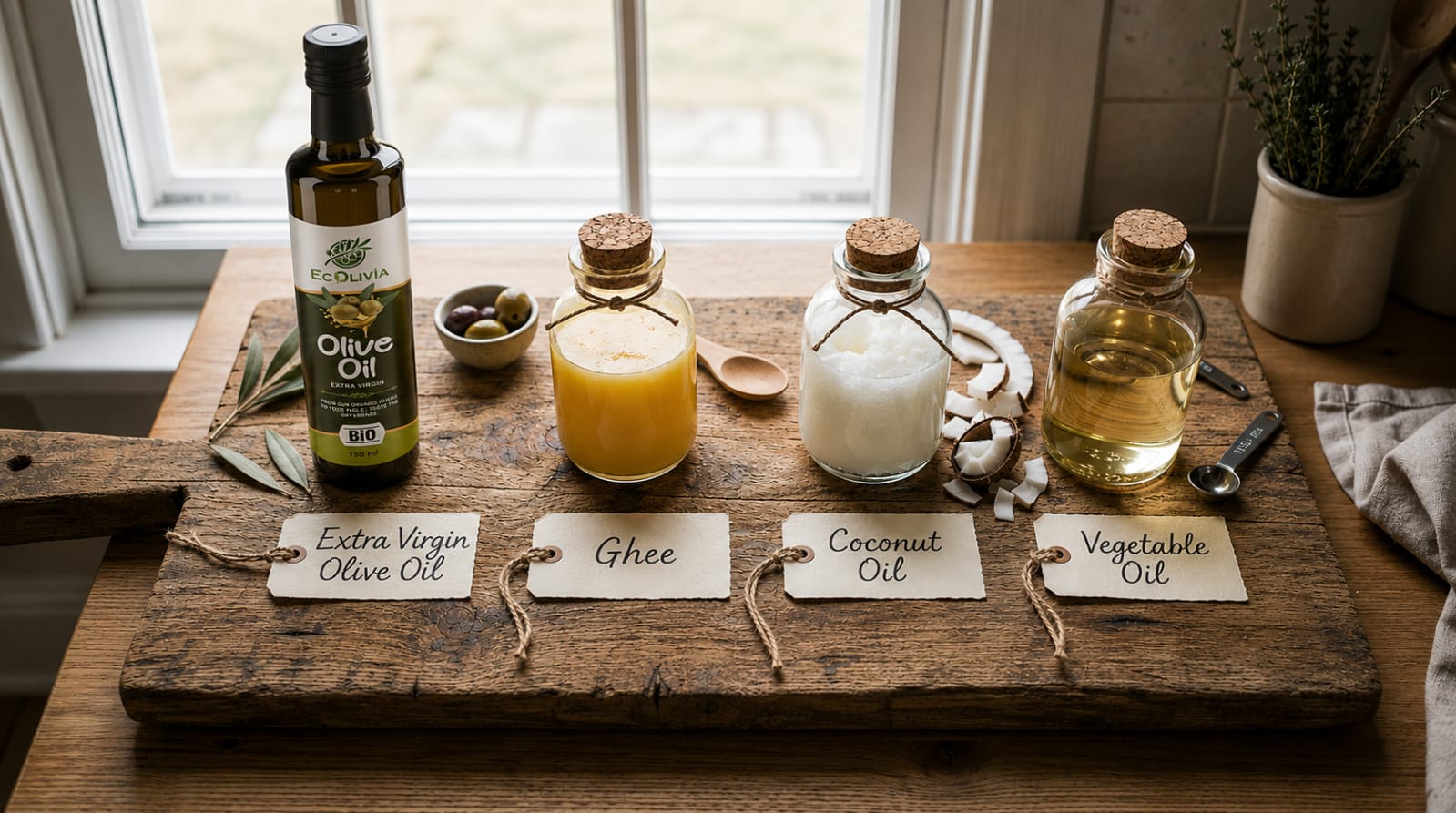
EVOO vs Ghee vs Vegetable Oil vs Coconut Oil: Which One Actually Wins?
By Ecolivia Team · May 2026 · 7 min read · For women who read ingredients before buying
Extra virgin olive oil Pakistan is the healthiest cooking oil you can use. I have a thing where I get annoyed by wellness trends. Coconut oil was going to fix everything thyroid, gut, hair, apparently. Then ghee got a rebrand and suddenly every food blogger was calling it ancient wisdom. Vegetable oil just sat there in the background for decades while nobody asked questions.
Extra Virgin Olive Oil Pakistan is different. Not because it’s trendy it’s actually been around forever but because it keeps showing up in real peer-reviewed research in ways the others simply don’t.
So here’s a proper comparison. Four oils, scored on things that actually matter to most of us. If you’re somewhere in your late 20s or 30s and starting to pay attention to this stuff, you deserve a straight answer rather than the usual ‘everything in moderation’ non-answer.
I went through the research. Here’s what I found.
――――――――――――――――――――
THE SCORECARD — AT A GLANCE
| EVOO | Ghee | Veg Oil | Coconut Oil |
Heart health | ✓✓✓ | ✓ | ✗ | ✓ |
Blood sugar | ✓✓✓ | ✓ | ✗ | ✗ |
Skin & hair | ✓✓✓ | ✓✓ | ✗ | ✓✓ |
Desi cooking | ✓✓ | ✓✓✓ | ✓✓ | ✓ |
Anti-inflammatory | ✓✓✓ | ✓ | ✗ | ✓ |
Everyday price | Medium | Medium | Low | Medium |
Overall winner | ★★★ | ★★ | ★ | ★★ |
✓✓✓ = Excellent · ✓✓ = Good · ✓ = Okay · ✗ = Poor
Round 1: Heart Health
This is honestly where I think the conversation needs to start. Not because I’m trying to scare anyone, but because the numbers for Pakistan specifically are bad enough that it feels dishonest to bury this lower down.
Vegetable oil — the daily default for millions of Pakistani kitchens
Most refined vegetable oil in Pakistan is a blend of palm oil, soybean, or sunflower all high in omega-6 fatty acids. In the right balance, omega-6 is fine. But when it’s the dominant fat in your diet every single day, it actively promotes inflammation. That’s not a neutral choice for your heart over the long run.
✗ Verdict: Not a heart-healthy choice. The research on refined vegetable oil is not kind.
Ghee — the nostalgic one
Ghee spent decades as the villain of Pakistani nutrition conversations. Turned out that wasn’t entirely fair. Saturated fat research has gotten more nuanced and ghee isn’t the straightforward heart-attack-in-a-jar it was made out to be. Used in moderate amounts, probably fine. But ‘probably fine’ is not the same as actually doing your heart any good.
✓ Verdict: Neutral in moderate amounts. Not protective. Not harmful if not overdone.
Coconut oil — the trendy one
Coconut oil has more saturated fat than ghee, which most people don’t realise. The MCT argument that its medium-chain triglycerides make it metabolise differently sounds compelling until you look at how small the quantities actually are in typical cooking. The American Heart Association put out a fairly direct advisory on this one. Their position is not positive.
✓ Verdict: Trendy but not well-supported by heart research. Better for occasional use.
Extra Virgin Olive Oil — the one with actual data
The fat makeup is about 73% oleic acid. What that does is lower LDL bad cholesterol without pulling HDL down with it. Most interventions that lower LDL also affect HDL. This one doesn’t. On top of that it reduces oxidative stress in the arteries, which is the slow internal damage that builds up quietly and then shows up as a blocked artery 20 years later. The PREDIMED trial one of the largest ever run on diet specifically found Extra Virgin Olive Oil Pakistan cut major cardiovascular events by 30%. That number is from a cooking oil. Still kind of wild to me.
✓✓✓ Verdict: Clear winner. The only cooking oil with serious, replicated cardiovascular research behind it.
According to Healthline, extra virgin olive oil Pakistan families should use has proven cardiovascular benefits backed by science.
Round 2: Blood Sugar & Diabetes Risk
My mother was diagnosed pre-diabetic last year. The doctor asked what oil they cook with. That’s when I started actually paying attention to this specific category.
Vegetable oil
High omega-6 intake is associated with increased insulin resistance over time. Not good. This is one of the more replicated findings in metabolic research.
✗ Verdict: Associated with worse insulin sensitivity long-term.
Ghee
Some small studies suggest ghee may nudge insulin sensitivity in a slightly positive direction. The evidence is early and not conclusive. Better than vegetable oil on this measure, but not by much.
✓ Verdict: Marginally okay. Not a meaningful intervention for blood sugar.
Coconut oil
The MCT argument comes up here again. Theoretically, ketones from MCTs could help stabilise blood sugar. In practice, the amounts you’d get from normal cooking are too small for it to show up meaningfully in most people. The research just isn’t there in real-world quantities.
✓ Verdict: Minimal real-world impact on blood sugar for typical use.
Extra Virgin Olive Oil
There’s a compound in Extra Virgin Olive Oil Pakistan called oleuropein. It slows down sugar absorption after eating so blood glucose doesn’t spike as sharply. It also makes cells more responsive to insulin, which is the actual core issue in Type 2 diabetes. A study in Diabetes Care tracked this properly and found 40% lower diabetes risk in people who used it regularly. I’ve now sent that study to three different family members.
✓✓✓ Verdict: Strongest evidence of any cooking oil for blood sugar management.
Round 3: Skin & Hair
If you’re using your cooking oil topically too which, honestly, more of us do than admit this round is for you.
Vegetable oil
High in omega-6 linoleic acid, which can actually be useful for some skin types. But refined versions are stripped of the nutrients that make it beneficial. Most proper beauty applications call for unrefined versions, which is not what’s sitting in your kitchen tin.
✗ Verdict: The refined version you cook with has minimal skincare value.
Ghee
Ghee has a long history in Ayurvedic skincare and I think dismissing that entirely is lazy. It is moisturising. It does have some anti-inflammatory properties when used on skin. For very dry skin specifically, it’s genuinely good. The problem is it’s heavy oily and combination skin types often react badly to it on the face.
✓✓ Verdict: Good for dry skin. Traditional use is well-founded. Not for every skin type.
Coconut oil
Decent moisturiser. However, it’s comedogenic clogs pores for a lot of people. Great for hair. On the face it’s a gamble depending on your skin type.
✓✓ Verdict: Excellent for hair. Hit or miss for face. Know your skin type before using.
Extra Virgin Olive Oil Pakistan
What makes Extra Virgin Olive Oil Pakistan different for skin is the squalene content. Squalene is structurally close to the skin’s own natural oils, which is why it actually absorbs instead of just pooling on top. I started using it on my face at night and the texture difference after a few weeks was noticeable enough that I stopped buying my usual moisturiser. Vitamin E and oleocanthal are also doing things repair, UV protection, anti-inflammation. For Pakistani skin that deals with dust, harsh sun, and hard water all year round, this combination is actually well-suited. And for hair, it penetrates the shaft rather than sitting on top of it. Less breakage over time, not just temporary shine.
✓✓✓ Verdict: Best all-rounder for skin and hair. Absorbs well, doesn’t clog, works from inside and outside.
Round 4: Cooking in a Desi Kitchen
✓ Verdict: Doesn’t suit desi flavour profiles. Not practical for most Pakistani cooking.
Extra Virgin Olive Oil
Smoke point sits around 190–210°C, which is honestly fine for most things Pakistani home cooks make on a regular basis tarka, sautéing, stir-frying, finishing a sabzi. The most practical swap I’ve found: instead of adding ghee at the end of daal, finish it with a tablespoon of Extra Virgin Olive Oil. The depth of flavour was better than I expected. For very high heat like deep frying a whole karahi? Ghee wins that one. But that’s maybe 20% of what most of us actually cook on most days.
✓✓ Verdict: Not ideal for very high heat frying. Perfect for everything else — including most daily desi cooking. Pakistani cooking involves heat. High heat, sometimes. This is the round where ghee and vegetable oil have been claiming the advantage for years. Let’s see if that holds up.
Vegetable oil
High smoke point. Cheap. Neutral flavour. It handles high heat fine. Genuinely its strongest argument. But ‘handles heat without breaking down’ doesn’t mean it’s good for you — it just means it doesn’t visibly burn.
✓✓ Verdict: Practical for high-heat frying. Just not healthy.
Ghee
Smoke point around 250°C. Handles Pakistani cooking beautifully. Adds flavour. This is where ghee legitimately wins and I’ll say that clearly.
✓✓✓ Verdict: Best for very high heat desi cooking. The one category where ghee has a real advantage.
Coconut oil
Medium smoke point. Adds a coconut flavour that just doesn’t work in most Pakistani dishes. Limited practical use in our kitchens.
Round 5: Anti-Inflammatory Properties
This is the round I find most relevant personally. Joint stiffness in the morning. Skin that flares up randomly. That low energy that isn’t really tiredness but something more like everything running slightly harder than it should. Chronic inflammation shows up in all of these ways and most people don’t connect it back to diet.
Vegetable oil
Excess omega-6 is pro-inflammatory. This isn’t a fringe position it’s one of the more replicated findings across nutrition research over the last couple of decades. The typical Pakistani diet already has a lot of omega-6 from other sources. Cooking oil adding more on top of that daily isn’t neutral.
✗ Verdict: Actively pro-inflammatory in the amounts most Pakistanis consume it.
Ghee
The butyrate in ghee does have anti-inflammatory properties in the gut specifically. That’s a real thing, not marketing. It’s just not as broad or as strong as what Extra Virgin Olive Oil Pakistan does.
✓ Verdict: Mild anti-inflammatory benefit, mainly in the gut.
Coconut oil
Some anti-inflammatory properties exist. The MCTs may help slightly. But the evidence is modest and inconsistent compared to EVOO.
✓ Verdict: Some benefit but not strongly evidenced.
Extra Virgin Olive Oil
Oleocanthal is the compound that makes Extra Virgin Olive Oil Pakistan interesting here. It inhibits COX-1 and COX-2 enzymes which is the exact same thing ibuprofen does. Not similar. The same pathway. I found this out and genuinely had to read it twice. For women dealing with hormonal flare-ups, persistent skin issues, or just that background ache that never fully goes away this isn’t a small thing used every single day.
✓✓✓ Verdict: Strongest anti-inflammatory cooking oil available. The science is consistent and replicated.
Round 6: Everyday Value
Price matters. Let’s be honest about it.
Vegetable oil wins on price, full stop. But here’s the thing you don’t use Extra Virgin Olive Oil Pakistan the way you use vegetable oil. You’re not deep-frying a whole karahi in it. A bottle used for tarkas, finishing dishes, the morning teaspoon routine, and occasional skin use lasts a lot longer than you’d think. The per-use cost ends up much closer than the bottle price makes it look.
✓✓ Verdict: Slightly pricier per bottle. Better value per actual use than it first appears.
――――――――――――――――――――
The Verdict
THE OVERALL WINNER
Extra Virgin Olive Oil Pakistan — by a significant margin.
Five of six categories. The one it doesn’t win very high heat cooking is a narrow loss, and for most of what Pakistani women actually cook day-to-day it’s perfectly adequate.
Ghee is a legitimate second place. It belongs in Pakistani cooking, particularly for high-heat dishes. Use it for that. Use Extra Virgin Olive Oil Pakistan for the rest.
Coconut oil is fine occasionally. Vegetable oil is the one worth genuinely reconsidering especially if it’s your main cooking oil in large quantities every day.
The simplest change: add a tablespoon of Extra Virgin Olive Oil Pakistan to one meal today. Tarka. Finishing drizzle. Morning teaspoon with warm water. One habit. Give it a month and see.
ecolivia.pk · Pure Pakistani Olive Oil